

As the seasons change, so do we


We look at our bodies, and it is easy to believe that we are something fixed. But beneath this apparent solidity, everything is moving.
Our cells are renewed. Our breath comes and goes. Our thoughts arise and disappear. Our emotions change. Our bodies adapt to the seasons, to what we eat, how we sleep, how we move, and what we experience.
Even what we call “I” is constantly being renewed, and what does it really consist of, if at all? This way of seeing can be one of the greatest sources of hope and liberation available to us.
Five elements, five layers
Two ancient traditions offer interesting ways of contemplating this multilayered nature of being: the Chinese understanding of Wu Xing, the Five Phases or Elements Theory, and the Yogic and Ayurvedic teaching of the Five Koshas, the layers or sheaths of our existence.

These are not the same system, and we should not force them into being one. They come from very different philosophical traditions. But placed gently beside one another, they can offer fascinating maps for reflecting on ourselves and the world we live in.
Wu Xing describes the continual movement and transformation of life through Wood, Fire, Earth, Metal, and Water. Each element is associated with a season, particular organs, qualities of energy, and patterns of transformation.
The koshas, described in the yogic tradition, offer another perspective: five increasingly subtle layers through which we can contemplate and gain a deeper understanding of our existence — from the outer layer of the physical body to the subtle dimensions of mind, awareness, and consciousness.
Both systems remind us of something easy to forget
We are multi-dimensional beings
We have a body. We have instincts. We have emotions. We have thoughts and intentions.
We have imagination, intuition, and a life force energy within us that is difficult to put into words. And all of these layers are in constant conversation with one another.
Moving with the seasons
The changing seasons give us a particularly beautiful way to observe this.
In Wu Xing, late summer/beginning of autumn is harvest season and belongs to the Earth element. Later autumn belongs to the Metal element, which is associated with the Lungs and Large Intestine. Autumn has a natural descending and contracting movement and expresses the important process of letting go.

Below a profound teaching from the Thai forest Master Ajahn Chah:
Do everything with a mind that lets go. Do not expect any praise or reward.
If you let go a little, you will have a little peace. If you let go a lot, you will have a lot of peace. If you let go completely, you will know complete peace and freedom, and your struggles with the world will come to an end.
The trees exemplify release without explanation. The leaves, once bright green, begin to change color. Eventually, they loosen their grip and fall effortlessly. There is something profoundly instructive in this. Autumn does not ask the tree to hold on to what has finished. It asks it to release. The release is necessary for the next phase to enter.

The wisdom of Earth
In the Wu Xing generating cycle, Earth gives birth to Metal.
Earth is associated with nourishment, stability, digestion and the centre. Metal follows Earth, just as autumn follows late summer. This offers an alternative way of thinking about seasonal balance. Before we move into the dryness, contraction and inward movement of autumn, we can benefit from remembering the qualities of Earth:
nourishment, grounding, warmth, stability and being held.
This is where tea enters my contemplation of the seasons
Not simply as a beverage. But as a means to come into deeper balance. A pause. A way of listening. A way of bringing an ancient understanding of nature into something as wonderfully ordinary as sitting down with a warm cup of fine tea.

A postfermented tea from Nepal
This autumn, one tea feels particularly appropriate to me.
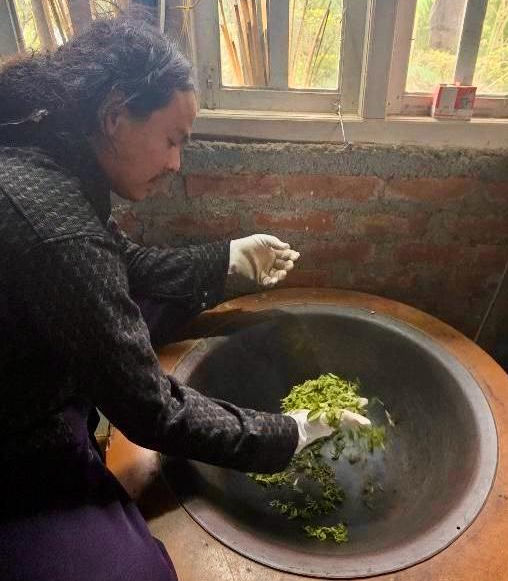
It is a tea similar to a shou Pu-erh made by Bibek Rai and his family in Nepal.
They call it Amam — Mother.
Amam tells a story
Mother is Earth.
Mother is nourishment.
Mother is the place from which we emerge and to which we eventually return.
A dark, post-fermented tea, with an earthy, grounding character.

The Season of Autumn
Traditionally, within Chinese medicine and the Five Element theory, autumn is a time when the lungs come into focus, and the dry quality of the air can challenge them. Earth, meanwhile, nourishes Metal in the Wu Xing cycle and supports the seasonal transition. The lungs work in pair with the large intestine, and this type of earth element tea is beneficial for our digestion, yet another reason to enjoy them during the transition phase from late summer to autumn and then slowly into winter.
And there is another layer to this story. The Amam — Mother tea itself is changing. Post-fermented teas are a living relationship between leaf, time, microorganisms, environment, and human care. This, and other post-fermented teas, will not taste the same years from now, just as we will not be the same people.
Nothing is fixed
The idea that nothing is fixed and that we can find peace by letting go is not something to be afraid of. It is where freedom and hope begin.
Starting from September 5th, you will be able to purchase Bibek Rai's teas at Långbrogård! A warm welcome!

Are you interested in learning more about tea and even receiving a valuable Diploma in tea? Read more here about the next Tea Sommelier Diploma Course, Level I. It's a cooperation between International Tea Academy and Tea.master.s since 2016.

Shana Zhang offers wonderful artisan, sustainable teas, made from, ancient, wild growing tea trees. Among them several post-feremented teas, find out all about them here!


Comments