

A tea called Amam - Mother... 💛🌸

Updated: Sep 6
Created by Hand, Shaped by Time ☯️
Every great tea carries stories: of the land where it was born, stories that unfold when you brew and enjoy each sip of it.

As summer gradually gives way to autumn, many of us are naturally drawn to post-fermented teas. Traditional Chinese Medicine has long regarded post-fermented teas as particularly supportive during seasonal transitions, when the body adjusts to changes in air and weather. When we move from late summer to autumn, these teas are traditionally enjoyed to support healthy digestion and to prepare the lungs for the colder and drier days ahead.

This tea is called Amam - Mother. Bibek’s mother is highly involved in the whole creation of this tea and other teas produced on the family farm. The name also fits so well with the harvesting season we are in right now, where Mother Earth provides us with all her gifts, a reminder of how we are directly linked to her; she is the foundation for our lives. And also because the post-fermented teas belong to the earth element, an element we are invited to nourish extra at this time of year to prepare for the colder season that is coming.
There’s something beautifully fitting about drinking aged tea at this time of year. The changing leaves, the trees letting them go without any effort, the cooler mornings, and the symphony of autumn colors echo the tea's own transitional journey through time.
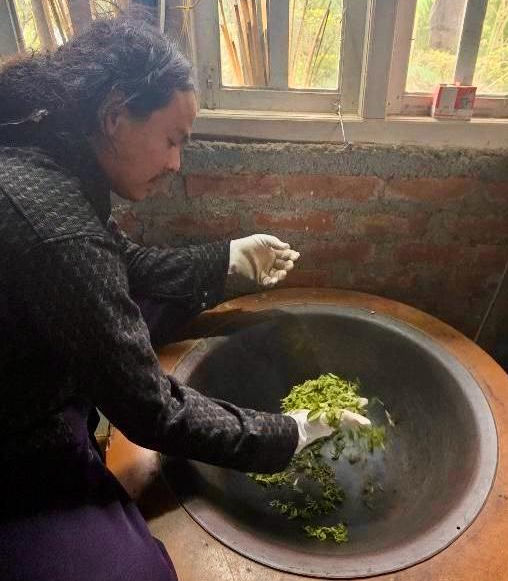
High in the hills around Fikkal in eastern Nepal, Bibek Rai and his family carefully select the leaves, harvested by hand, and transform them into these beautiful post-fermented Amam tea balls. When the tea has been produced, shaped, and dried, each ball symbolizes a small work of art that can be stored for ages.

Holding one of these tea balls in your hand, you immediately sense that this tea possesses a strong Cha Qi (茶气 tea energy). Each Amam tea ball weighs around 5–6 grams, and its aroma and flavors unfold and change over many infusions.
This tea you are invited to enjoy throughout the whole day, together with your family or some good friends. With each steep, another message appears—earthy, smooth, gently sweet, fruity, always quietly complex. Unlike many teas that are enjoyed at their freshest, post-fermented teas invite us to think differently about time. They remind us that some things become more beautiful with age if cared for properly. As the years pass, this tea will continue its slow transformation, developing greater depth, smoothness, and elegance.
Perhaps that is one of the reasons pu-erh and other postfermented or dark teas have fascinated tea lovers for centuries. It teaches us that ageing is not decline, but refinement. I hope that when you unwrap one, you will pause for a moment before brewing—noticing the flowers, the careful wrapping and the hands that prepared it—and remember that every exceptional tea carries the story of the people who made it.

Sometimes, the most extraordinary journeys begin with a single leaf.
It is with great joy that I will soon be able to offer you these remarkable artisan tea balls and other teas from Bibek Rai’s family at Långbrogård in Mölnbo.
Welcome to learn about Tea.master.s and the International Tea Academy's upcoming Tea Sommelier Diploma Course. . It is planned to start in the Autumn of 2026.


Comments